-
Shop
- Advanced Technologies
- AI Career Advantage Collection
- AI Skills
- AI Skills for Creators & Freelancers
- AI Client Management
- AI Ethics
- AI Mindset
- AI Tools & Prompts
- AI Writing & Content Creation
- Audio, Voice & Music
- Design & Visual Creation
- Email, Messaging & Communication
- Freelancing & Business
- Marketing, Ads & Conversion
- Productivity, Workflow & Automation
- SEO & Search Optimization
- Social Media Content & Growth
- Strategy, Planning & Analytics
- Video Creation & Editing
- AI Skills Mastery 2026 Collection
- Bathroom
- Calvin Klein
- Car Accessories
- Confidence
- Dating & Social Skills
- Digital Resources
- Beauty
- Budgeting & Saving
- Car Buying & Ownership
- Cozy Feast Collection
- Electronics & Technology
- Emotional Intelligence
- Entrepreneurship & Business Growth
- Financial Education
- Financial Independence
- Financial Mindset & Psychology
- Goal Setting
- Hobbies
- Home Styling & Organization
- Leadership
- Mindfulness
- Mindset
- Motivation
- Online Business
- Parenting & Child Development
- Personal Style & Fashion
- Pet Lifestyle & Wellness
- Positive Thinking
- Productivity
- Self Confidence
- Sleep Improvement
- Smart Life with AI
- Stress Management & Relaxation
- Travel Planning
- Wellness
- Yoga & Fitness
- Yoga & Mind-Body Practices
- Education & Learning
- Family & Parenting
- Furniture
- Health & Wellness
- Home Electronics
- Kitchen
- Lighting
- Luxury Brands Collection
- Nike
- Online Business for Beginners
- Parenting Guides Collection
- Patio, Lawn & Garden
- Personal Growth
- Pet Care
- Pet Supplies
- Smart Amazon Shopping
- Smart Home Living Guides
- TikTok Growth & Monetization Mastery
- Travel
- Travel & Adventure
- Wealth
- Wealth Building
- Popular
- Best deals



Product Description
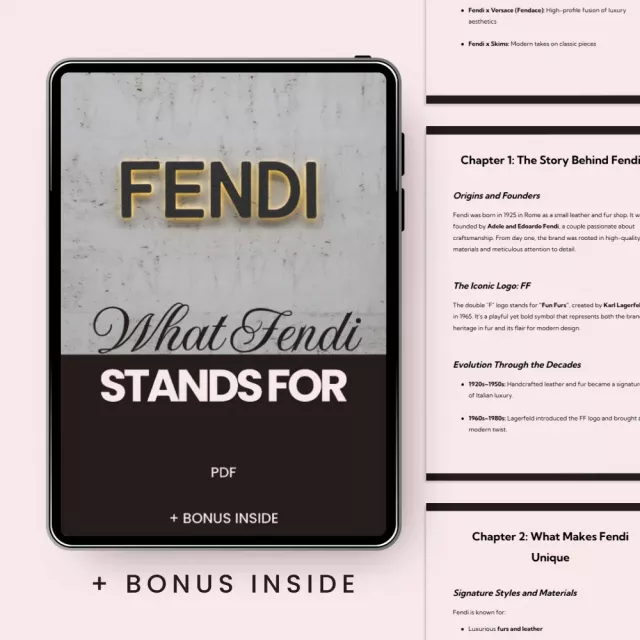
Transform Your Wardrobe with Modern Fendi Style
Step into a world of luxury with the “Modern Fendi Look for Effortless Luxury” guide. This digital download is your personal roadmap to mastering Fendi-inspired style, designed for those who crave timeless elegance with a contemporary edge. Whether you’re looking to elevate your everyday wardrobe or curate a statement look, this guide provides all the insights and practical advice you need to embody the essence of Fendi. Learn how to mix bold elements with classic pieces to achieve that perfect balance of sophistication and modernity.
Key Features & Contents:
- Chapter 1: The Foundations of Modern Fendi Style, exploring the philosophy and signature elements that define the look
- Chapter 2: How to Build Modern Fendi-Inspired Outfits, including tips on core pieces, accessories, and AI-driven styling prompts
- Chapter 3: Adapting Fendi Style to Everyday Life, with practical advice for casual, professional, and evening looks
- Chapter 4: Thinking Like a Luxury Stylist, teaching you how to stay relevant as trends evolve and how confidence completes your look
Why This Guide is Perfect for You
Are you someone who admires the luxurious yet effortlessly chic look of Fendi, but doesn’t know where to start? This guide is tailor-made for fashion enthusiasts, professionals, and anyone looking to integrate modern Fendi style into their life. It offers easy-to-follow instructions and examples on how to build Fendi-inspired outfits for all occasions. If you’re looking to create a signature look that radiates confidence and timeless luxury, this is the resource for you.
What Makes This Guide Stand Out?
The “Modern Fendi Look for Effortless Luxury” is more than just another style book. It blends practical fashion advice with real-world case studies, helping you understand how to transform a simple outfit into a Fendi-inspired statement. With actionable tips on everything from core pieces to AI-driven styling, this guide is designed to provide a modern approach to luxury dressing—without the over-the-top complexities. Unlike other resources, it also helps you adapt high-end fashion to your everyday life.
Benefits of the Guide
- Learn the core principles of Fendi style, balancing classic and contemporary elements
- Gain confidence in your ability to create Fendi-inspired outfits that fit your lifestyle
- Discover common mistakes to avoid and how to avoid breaking the luxury effect
- Utilize AI to generate your own Fendi-inspired looks, keeping your wardrobe fresh and innovative
- Master the art of accessorizing, adding bold but controlled statement pieces to your outfits
Ready to Elevate Your Style?
Don’t miss out on this exclusive guide to unlocking your inner luxury stylist. Download the “Modern Fendi Look for Effortless Luxury” today and begin your journey toward a wardrobe that exudes timeless elegance and modern flair. It’s time to look chic, confident, and effortlessly luxurious every day.
Shipping & Delivery
SHIPPING
We are proud to offer international shipping services that currently operate in over 200 countries and islands world wide. Nothing means more to us than bringing our customers great value and service. We will continue to grow to meet the needs of all our customers, delivering a service beyond all expectation anywhere in the world.
Do you ship worldwide?
Yes. We provide free shipping to over 200 countries around the world. However, there are some locations we are unable to ship to. If you happen to be located in one of those countries we will contact you.
What about customs?
We are not responsible for any custom fees once the items have been shipped. By purchasing our products, you consent that one or more packages may be shipped to you and may get custom fees when they arrive to your country.
How long does shipping take?
Shipping time varies by location. These are our estimates:| Location | *Estimated Shipping Time |
|---|---|
| United States | 5-20 Business days |
| Canada, Europe | 5-20 Business days |
| Australia, New Zealand | 5-20 Business days |
| Central & South America | 5-25 Business days |
| Asia | 5-20 Business days |
| Africa | 5-25 Business days |
Do you provide tracking information?
Yes, you will receive an email once your order ships that contains your tracking information. If you haven’t received tracking info within 5 days, please contact us.
My tracking says “no information available at the moment”.
For some shipping companies, it takes 2-5 business days for the tracking information to update on the system. If your order was placed more than 5 business days ago and there is still no information on your tracking number, please contact us.
Will my items be sent in one package?
For logistical reasons, items in the same purchase will sometimes be sent in separate packages, even if you've specified combined shipping.
If you have any other questions, please contact us and we will do our best to help you out.
RETURNS
Order cancellation
All orders can be cancelled until they are shipped. If your order has been paid and you need to make a change or cancel an order, you must contact us within 12 hours. Once the packaging and shipping process has started, it can no longer be cancelled.
Refunds
Your satisfaction is our #1 priority. Therefore, you can request a refund or reshipment for ordered products if:
- If you did not receive the product within the guaranteed time (45 days not including 1-3 day processing) you can request a refund or a reshipment.
- If you received the wrong item you can request a refund or a reshipment.
- If you do not want the product you’ve received you may request a refund but you must return the item at your expense and the item must be unused.
We do not issue the refund if:
- Your order did not arrive due to factors within your control (i.e. providing the wrong shipping address)
- Your order did not arrive due to exceptional circumstances outside the control of megaselectionsnook.shop (i.e. not cleared by customs, delayed by a natural disaster).
- Other exceptional circumstances outside the control of megaselectionsnook.shop.
*You can submit refund requests within 15 days after the guaranteed period for delivery (45 days) has expired. You can do it by sending a message on Contact Us page
If you are approved for a refund, then your refund will be processed, and a credit will automatically be applied to your credit card or original method of payment, within 14 days.
Exchanges
If for any reason you would like to exchange your product, perhaps for a different size in clothing, you must contact us first and we will guide you through the steps.
Please do not send your purchase back to us unless we authorise you to do so.
Refunds & Returns
Order cancellation
All orders can be cancelled until they are shipped. If your order has been paid and you need to make a change or cancel an order, you must contact us within 12 hours. Once the packaging and shipping process has started, it can no longer be cancelled.
Refunds
Your satisfaction is our #1 priority. Therefore, you can request a refund or reshipment for ordered products if:
- If you did not receive the product within the guaranteed time( 45 days not including 2-5 day processing) you can request a refund or a reshipment.
- If you received the wrong item you can request a refund or a reshipment.
- If you do not want the product you’ve received you may request a refund but you must return the item at your expense and the item must be unused.
We do not issue the refund if:
- Your order did not arrive due to factors within your control (i.e. providing the wrong shipping address)
- Your order did not arrive due to exceptional circumstances outside the control of megaselectionsnook.shop (i.e. not cleared by customs, delayed by a natural disaster).
- Other exceptional circumstances outside the control of https://marvellio.com
*You can submit refund requests within 15 days after the guaranteed period for delivery (45 days) has expired. You can do it by sending a message on Contact Us page
If you are approved for a refund, then your refund will be processed, and a credit will automatically be applied to your credit card or original method of payment, within 14 days.
Exchanges
If for any reason you would like to exchange your product, perhaps for a different size in clothing. You must contact us first and we will guide you through the steps.
Please do not send your purchase back to us unless we authorise you to do so.
Customer Reviews
See why hundreds love this product and trust us
Based on 48 reviews
Write a Review
We Think You’ll Love
Top picks just for you










The case study that takes a plain black trousers and white shirt combo and turns it into something elevated using just three steps — add structure, introduce a statement element, maintain balance — was the moment everything clicked. I tried it the same evening with pieces I already owned and my roommate asked where I was going. I wasn't going anywhere. I was just dressed with intention for the first time.
The idea that accessories are strategic tools, not afterthoughts, reframed how I think about every outfit.
Expressive sophistication — two words that finally named what I've been trying to do with my closet 🖤
The common mistakes section called me out on overloading outfits with competing statement pieces. Less really is more.
The section on looking expensive without overdressing was where I spent the most time. The five upgrades — prioritize fit, choose better fabrics, simplify your color palette, add one distinctive element, maintain consistency — sound basic until you actually audit your wardrobe against them. I failed three of five and fixed two that same week with zero new purchases.
Thorough styling guide with strong foundational advice. Some sections lean more toward philosophy than specific how-to, which left me wanting more concrete outfit breakdowns beyond the single case study. The AI prompts help bridge that gap somewhat.
The balance between classic and contemporary — one foundation piece plus one modern focal point — is the simplest formula I've found for looking put together.
The four signature elements — structure, contrast, statement focus, effortless appearance — gave me a vocabulary for what I'd been doing by instinct.
Used the AI prompt about creating a weekly wardrobe plan inspired by modern Italian luxury and it pulled together five days of outfits from what I already own. Saved me an hour of morning decisions.
Well-written and the core concepts are solid. I would have liked more visual examples or photo references to accompany the styling advice — reading about contrast and structure is helpful but seeing it would make the principles stick faster.
⭐🔥👏
The professional settings section — clean silhouettes, neutral palettes, one refined statement piece — changed how I dress for work. My manager mentioned I looked more polished at our last client meeting. I hadn't bought anything new. I just applied the framework.
Confidence is the ultimate indicator of alignment — wrote that on a sticky note.
Decent style guide but some of the advice — like prioritizing fit and simplifying color palettes — will feel obvious to anyone who already follows fashion. The AI prompts and the long-term style development strategy near the end are the most original sections.
The restraint principle — one focal point per outfit, everything else supports it — immediately improved every look I put together.
The section on adapting the same principles across casual, professional, and evening settings made this feel practical instead of aspirational. I used all three versions in one week.
Bold without chaotic, luxurious without forced — that tension is everything.
Good framework overall. The mistake about copying trends without adapting them to your own identity was useful but I wished for more examples of what adaptation actually looks like in practice. The principles are right, just wanted more specificity in places.
The idea that modern luxury is about wearing pieces that feel intentional rather than expensive shifted my entire perspective on shopping.
I've been teaching personal styling for six years and this PDF captures something most guides miss: the difference between copying an outfit and understanding the thinking behind it. The section on thinking like a luxury stylist reframes style as a long-term practice rather than a series of purchases. My clients who struggle with consistency would benefit from the four-step signature look process — evaluate, strengthen foundations, introduce personality gradually, observe and refine. I've already started referencing it in sessions.
❤️👌✨🔥
Helpful guide but the evening styling section felt thinner than the casual and professional ones. A few more specific evening outfit examples would round it out. The core framework and the common mistakes section are strong throughout.
The fabric advice alone upgraded my look — materials that hold their shape naturally appear more premium, and I'd never thought about it that way.
Read it on the train, applied it at dinner. That fast.
The point about luxury brands staying relevant by evolving strategically instead of randomly — and applying that same principle to your own wardrobe — was the best takeaway in the whole guide. It turned style from something reactive into something I actually plan.
The long-term style development strategy felt a bit broad — consistency, quality over quantity, self-awareness, patience. The concepts are correct but I wanted more tactical steps. The AI prompt section and the outfit-building framework earlier in the guide are more actionable.
Flowing fabric paired with sharp tailoring — tried that contrast tip and got three compliments 🤎
The wardrobe evaluation step — identifying what already works and what feels disconnected — was surprisingly hard and surprisingly useful.
Accessories as identity communicators, not afterthoughts. That one line changed my approach.
I used to think looking expensive meant buying expensive. The five practical upgrades section proved me wrong — I focused on fit and a simplified color palette first, and the difference was immediate. My coworkers started asking if I'd gone shopping. I hadn't spent a dollar.
Solid introduction to luxury styling principles. A few of the concepts are covered in similar fashion guides, but the Fendi-specific lens and the AI prompt integration give it a fresh angle. The case study on transforming a basic outfit is the standout section.
👏💛👍
The guide taught me that statement pieces only work when the rest of the outfit is quiet enough to let them speak. I'd been layering bold items on top of each other and wondering why my outfits felt busy.
The AI prompt about analyzing personal style and recommending improvements based on luxury fashion principles gave me a full breakdown I've been working through for two weeks now. The guide set the framework and AI filled in the details.
Good styling guide with a clear structure. I'd like to have seen the casual section explore more relaxed silhouettes — the examples skew slightly formal even for casual. The professional and evening breakdowns are well done.
The point about introducing personality gradually instead of overhauling everything at once saved me from a closet purge I would have regretted. I've been adding one piece at a time and my style has evolved more in two months than it did in the past year of impulse shopping.
Clean trousers, structured jacket, one distinctive accessory — that casual formula works every time.
This is the first style guide I've read that treats confidence as the final styling element rather than something separate from clothing. That integration made the whole approach feel grounded instead of superficial.
The idea of adapting trends selectively instead of chasing all of them is such a relief to actually see in writing. The questions — does this align with my style, does it strengthen my identity — are now my pre-purchase filter. I've skipped four impulse buys since reading this and don't miss any of them. Before this guide I was constantly reacting to whatever I saw online. Now I have a lens to sort through it all.
Every section earns its space — nothing felt padded.
Strong personality plus refined control — that's the tension this whole guide is built on and it works 🔥
The common mistakes section — especially the part about even expensive clothing losing its effect with poor fit — was the reality check I needed. I'd been prioritizing labels over tailoring for years.
Some styling advice overlaps with what you'd find in general luxury fashion guides, and the long-term development section stays somewhat abstract. That said, the outfit-building method, the three-setting adaptation, and the AI prompts make it worth the read for anyone looking to build a more intentional wardrobe.
⭐👜🔥💅
The guide taught me to think in terms of one classic foundation plus one modern focal point — and that formula translates to every setting, from brunch to boardrooms.
Practical guide with a solid framework. I wanted slightly more depth on how fabric choice specifically impacts the luxury effect — the guide mentions it but doesn't go far enough. The AI styling prompts and the four-step signature look process are useful additions.
The shift from copying outfits to understanding the thinking behind them is the best framing for long-term style I've come across. I'm not dressing like anyone else now — I'm dressing like a more intentional version of myself.
Shared it with my sister who constantly says she has nothing to wear — she built three new outfits from her existing closet that same night.