-
Shop
- Advanced Technologies
- AI Career Advantage Collection
- AI Skills
- AI Skills for Creators & Freelancers
- AI Client Management
- AI Ethics
- AI Mindset
- AI Tools & Prompts
- AI Writing & Content Creation
- Audio, Voice & Music
- Design & Visual Creation
- Email, Messaging & Communication
- Freelancing & Business
- Marketing, Ads & Conversion
- Productivity, Workflow & Automation
- SEO & Search Optimization
- Social Media Content & Growth
- Strategy, Planning & Analytics
- Video Creation & Editing
- AI Skills Mastery 2026 Collection
- Bathroom
- Calvin Klein
- Car Accessories
- Confidence
- Dating & Social Skills
- Digital Resources
- Beauty
- Budgeting & Saving
- Car Buying & Ownership
- Cozy Feast Collection
- Electronics & Technology
- Emotional Intelligence
- Entrepreneurship & Business Growth
- Financial Education
- Financial Independence
- Financial Mindset & Psychology
- Goal Setting
- Hobbies
- Home Styling & Organization
- Leadership
- Mindfulness
- Mindset
- Motivation
- Online Business
- Parenting & Child Development
- Personal Style & Fashion
- Pet Lifestyle & Wellness
- Positive Thinking
- Productivity
- Self Confidence
- Sleep Improvement
- Smart Life with AI
- Stress Management & Relaxation
- Travel Planning
- Wellness
- Yoga & Fitness
- Yoga & Mind-Body Practices
- Education & Learning
- Family & Parenting
- Furniture
- Health & Wellness
- Home Electronics
- Kitchen
- Lighting
- Luxury Brands Collection
- Nike
- Online Business for Beginners
- Parenting Guides Collection
- Patio, Lawn & Garden
- Personal Growth
- Pet Care
- Pet Supplies
- Smart Amazon Shopping
- Smart Home Living Guides
- TikTok Growth & Monetization Mastery
- Travel
- Travel & Adventure
- Wealth
- Wealth Building
- Popular
- Best deals


Product Description
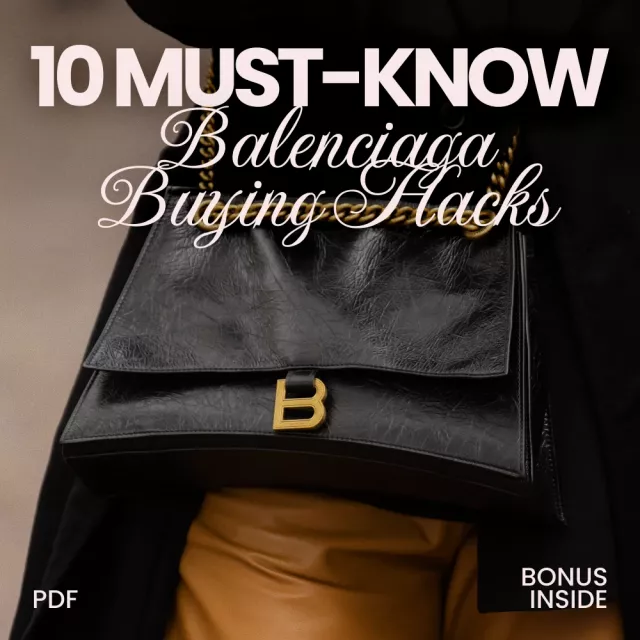
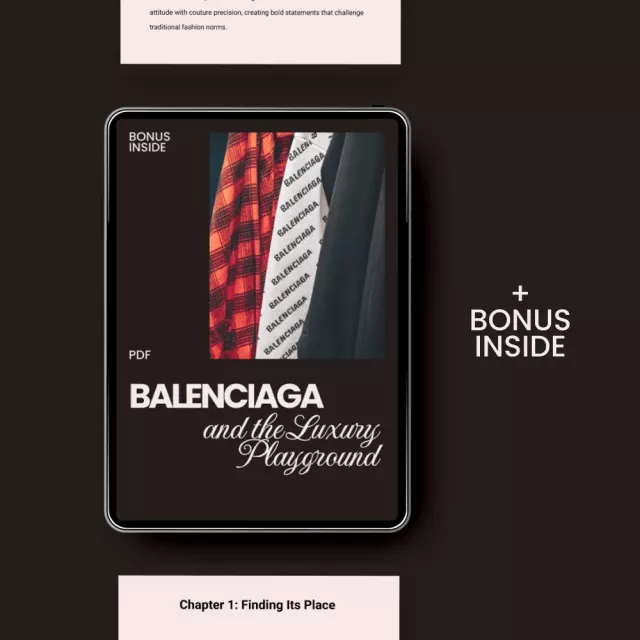
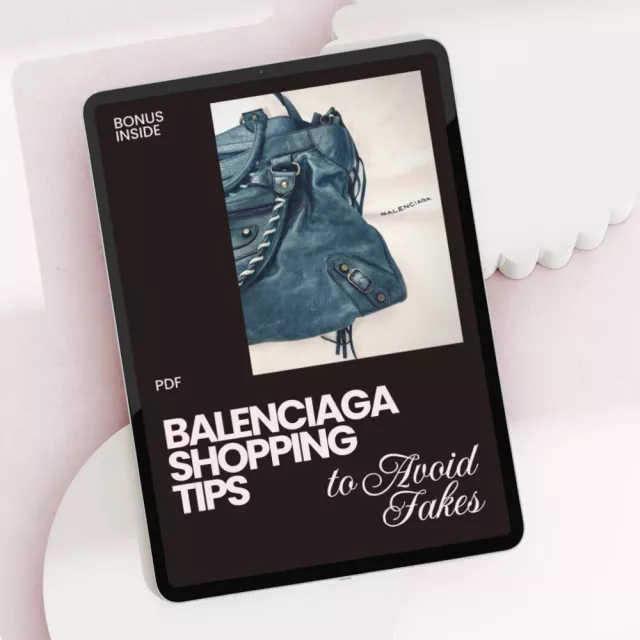
Discover the Unmatched Influence of Balenciaga on Fashion
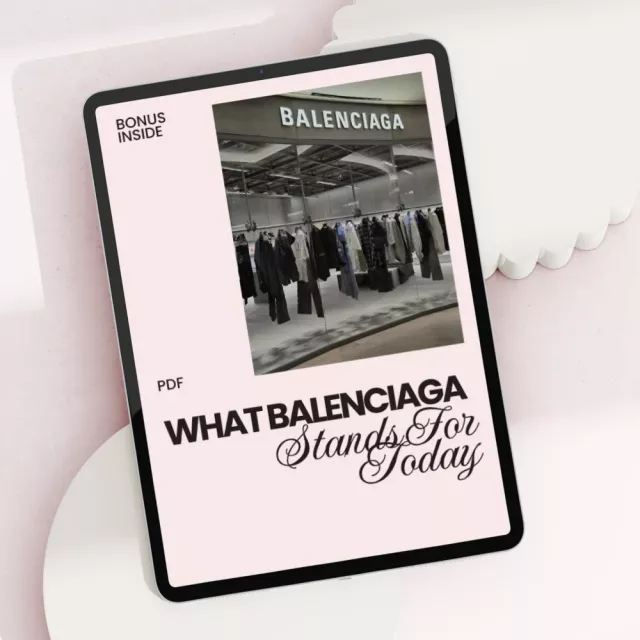
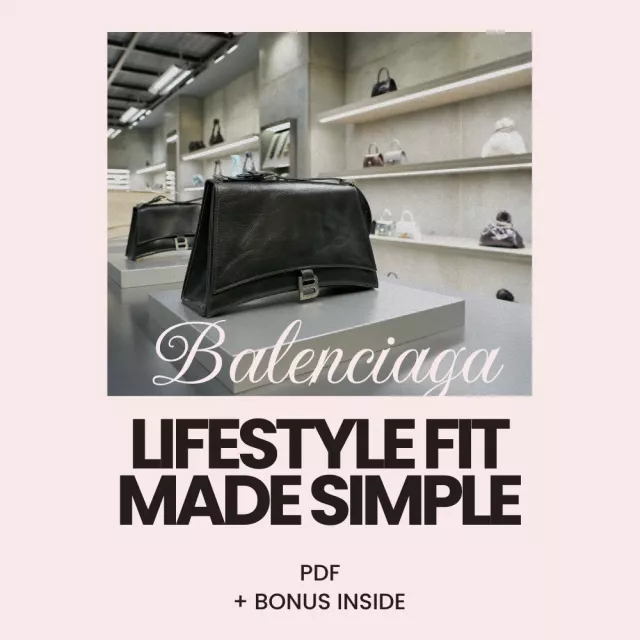
Step into the world of cutting-edge style with “How Balenciaga Shapes Fashion,” a comprehensive guide that unveils the groundbreaking impact of the iconic Balenciaga brand on modern fashion trends. From redefining streetwear to pushing boundaries with bold design choices, this guide covers the elements that make Balenciaga a leader in the fashion industry. Whether you’re a designer, fashion enthusiast, or trend forecaster, this resource will arm you with the knowledge to understand the brand’s unique DNA and how it continues to shape the future of style.
Inside this guide, you’ll explore key insights into how Balenciaga challenges traditional fashion norms, the power of collaborations, and how streetwear meets luxury. Learn about the brand’s profound influence on the fashion world, plus tips on spotting emerging trends using advanced tools like AI.
Key Features and Contents of This Guide:
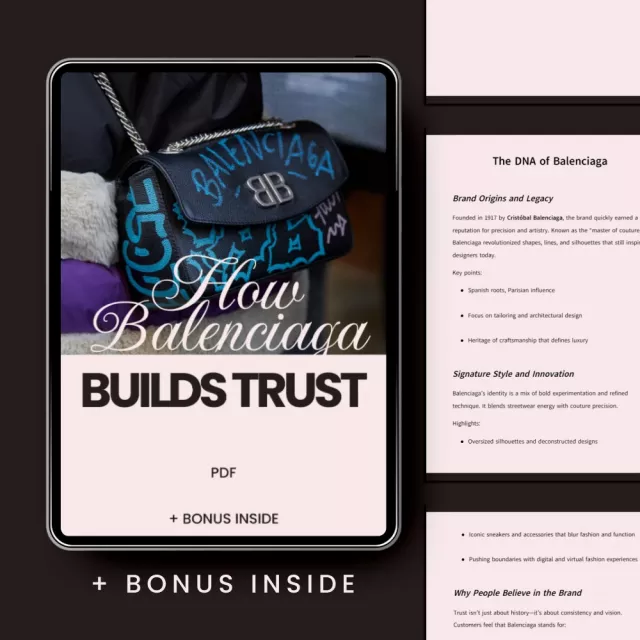
- Chapter 1: The Balenciaga Effect – Learn about the brand’s DNA, how it challenges norms, and iconic moments that shifted trends.
- Chapter 2: Street Meets Runway – Dive into how sneakers, hoodies, and statement pieces took over the runway, and the role social media and meme culture played in shaping modern fashion.
- Chapter 3: Lessons in Influence – Get a deep dive into case studies like the Triple S Sneakers, common mistakes brands make, and how to spot emerging trend signals.
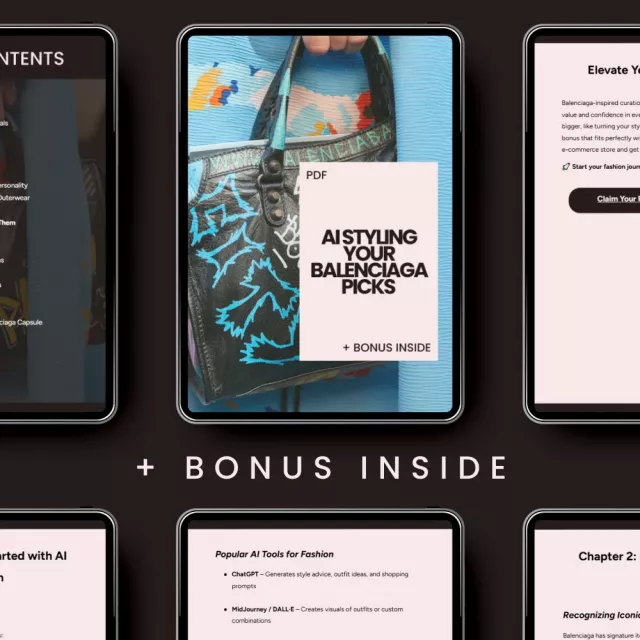
- Chapter 4: AI-Powered Trend Exploration – Unlock the potential of AI to predict upcoming trends and explore practical tips, including prompt examples for ChatGPT and MidJourney, and free tools to experiment with fashion trends.
Why You Need This Guide
Are you a fashion professional, aspiring designer, or trend enthusiast looking to stay ahead of the curve? This guide is perfect for anyone eager to understand the Balenciaga brand influence on trends and how to apply this knowledge in their own work. Whether you’re looking to grasp the brand’s unique approach to fashion or to experiment with AI to predict upcoming styles, this guide offers practical, actionable insights that will help you make better-informed fashion decisions.
Unlike other fashion guides, “How Balenciaga Shapes Fashion” is the ultimate resource for those wanting a modern, tech-driven approach to trendspotting. By combining Balenciaga’s historical impact with cutting-edge AI trend exploration, it gives you the tools to not only understand past trends but also predict future movements in the fashion world.
Get Your Copy Today!
Don’t miss out on this essential guide. Download “How Balenciaga Shapes Fashion” today and start understanding the influence that’s changing the fashion industry. Whether you’re an aspiring designer or a fashion industry veteran, this guide is your roadmap to understanding the trends shaping the future of style.
Shipping & Delivery
SHIPPING
We are proud to offer international shipping services that currently operate in over 200 countries and islands world wide. Nothing means more to us than bringing our customers great value and service. We will continue to grow to meet the needs of all our customers, delivering a service beyond all expectation anywhere in the world.
Do you ship worldwide?
Yes. We provide free shipping to over 200 countries around the world. However, there are some locations we are unable to ship to. If you happen to be located in one of those countries we will contact you.
What about customs?
We are not responsible for any custom fees once the items have been shipped. By purchasing our products, you consent that one or more packages may be shipped to you and may get custom fees when they arrive to your country.
How long does shipping take?
Shipping time varies by location. These are our estimates:| Location | *Estimated Shipping Time |
|---|---|
| United States | 5-20 Business days |
| Canada, Europe | 5-20 Business days |
| Australia, New Zealand | 5-20 Business days |
| Central & South America | 5-25 Business days |
| Asia | 5-20 Business days |
| Africa | 5-25 Business days |
Do you provide tracking information?
Yes, you will receive an email once your order ships that contains your tracking information. If you haven’t received tracking info within 5 days, please contact us.
My tracking says “no information available at the moment”.
For some shipping companies, it takes 2-5 business days for the tracking information to update on the system. If your order was placed more than 5 business days ago and there is still no information on your tracking number, please contact us.
Will my items be sent in one package?
For logistical reasons, items in the same purchase will sometimes be sent in separate packages, even if you've specified combined shipping.
If you have any other questions, please contact us and we will do our best to help you out.
RETURNS
Order cancellation
All orders can be cancelled until they are shipped. If your order has been paid and you need to make a change or cancel an order, you must contact us within 12 hours. Once the packaging and shipping process has started, it can no longer be cancelled.
Refunds
Your satisfaction is our #1 priority. Therefore, you can request a refund or reshipment for ordered products if:
- If you did not receive the product within the guaranteed time (45 days not including 1-3 day processing) you can request a refund or a reshipment.
- If you received the wrong item you can request a refund or a reshipment.
- If you do not want the product you’ve received you may request a refund but you must return the item at your expense and the item must be unused.
We do not issue the refund if:
- Your order did not arrive due to factors within your control (i.e. providing the wrong shipping address)
- Your order did not arrive due to exceptional circumstances outside the control of megaselectionsnook.shop (i.e. not cleared by customs, delayed by a natural disaster).
- Other exceptional circumstances outside the control of megaselectionsnook.shop.
*You can submit refund requests within 15 days after the guaranteed period for delivery (45 days) has expired. You can do it by sending a message on Contact Us page
If you are approved for a refund, then your refund will be processed, and a credit will automatically be applied to your credit card or original method of payment, within 14 days.
Exchanges
If for any reason you would like to exchange your product, perhaps for a different size in clothing, you must contact us first and we will guide you through the steps.
Please do not send your purchase back to us unless we authorise you to do so.
Refunds & Returns
Order cancellation
All orders can be cancelled until they are shipped. If your order has been paid and you need to make a change or cancel an order, you must contact us within 12 hours. Once the packaging and shipping process has started, it can no longer be cancelled.
Refunds
Your satisfaction is our #1 priority. Therefore, you can request a refund or reshipment for ordered products if:
- If you did not receive the product within the guaranteed time( 45 days not including 2-5 day processing) you can request a refund or a reshipment.
- If you received the wrong item you can request a refund or a reshipment.
- If you do not want the product you’ve received you may request a refund but you must return the item at your expense and the item must be unused.
We do not issue the refund if:
- Your order did not arrive due to factors within your control (i.e. providing the wrong shipping address)
- Your order did not arrive due to exceptional circumstances outside the control of megaselectionsnook.shop (i.e. not cleared by customs, delayed by a natural disaster).
- Other exceptional circumstances outside the control of https://marvellio.com
*You can submit refund requests within 15 days after the guaranteed period for delivery (45 days) has expired. You can do it by sending a message on Contact Us page
If you are approved for a refund, then your refund will be processed, and a credit will automatically be applied to your credit card or original method of payment, within 14 days.
Exchanges
If for any reason you would like to exchange your product, perhaps for a different size in clothing. You must contact us first and we will guide you through the steps.
Please do not send your purchase back to us unless we authorise you to do so.
Customer Reviews
See why hundreds love this product and trust us
Based on 37 reviews
Write a Review
We Think You’ll Love
Top picks just for you











The Triple S case study table mapping bold innovation, controlled scarcity, and amplification to actionable brand lessons is something I've already dropped into two client decks. Most trend guides describe what happened — this one explains why it worked and how to replicate the mechanics. The emerging trend signals section on watching micro-influencers and niche Discord communities gave my team a scouting framework we didn't have before.
I run a streetwear label and the common mistakes section described every misstep we made in our first year — chasing trends too late, overcomplicating design, ignoring meme culture entirely. Reading it felt like a debrief of our own failures with fixes attached. The trend signal checklist about watching micro-influencers and niche TikTok communities changed how my team scouts ideas. We spotted a silhouette trend three months early by monitoring the exact channels this guide suggested. The AI tools section then let us visualize the concept in MidJourney before committing production budget. Before this PDF, we were reactive. Now we're consistently two steps ahead of competitors who are still scrolling the same mainstream feeds. I've bought copies of this for my entire design team.
Turning everyday items into status symbols — that framing captured Balenciaga's entire strategy in one line.
The meme-worthy marketing analysis gave me language for something I've been trying to explain to clients for months 🔥
Sock boots inspiring mass-market copies — the ripple effect examples make the influence concrete, not theoretical.
The brand DNA section on luxury meeting street and minimalism colliding with exaggeration set the tone perfectly. Everything after it builds on that central tension. The common mistakes list was sharp — especially the point about ignoring digital culture and missing viral potential. I shared that page with a brand director who still doesn't take TikTok seriously.
Scarcity driving desirability — the controlled-drop lesson from the Triple S study applies to any product category.
The AI trend forecasting section mentioning Heuritech and WGSN AI introduced me to tools I'd never heard of. Pattern recognition in social media posts and hashtags is exactly how I want my team working — this guide made the workflow tangible instead of abstract.
Quick, structured, and every section earns its place.
💯🔥⭐🖤
The video game tie-ins reaching younger audiences — that collaboration insight opened a channel I hadn't considered for my own brand strategy.
Good trend analysis overall but the AI section could go deeper into how to actually use the free tools listed. Mentioning Google Trends and NightCafe without walking through a specific workflow leaves beginners guessing. The Triple S case study and emerging signals framework are strong enough to justify the read on their own though.
Campaigns that invite memes increasing brand visibility — that strategic framing of virality clicked instantly.
The lessons table in the Triple S study is the most useful single page I've read on fashion influence this year. Bold innovation mapped to breaking shape norms, controlled scarcity mapped to limited editions driving urgency, amplification mapped to social proof — each row gave me an action I could take back to my team the same afternoon.
Chasing trends too late losing originality — the simplest warning and the one most brands still ignore.
The ChatGPT prompt about analyzing streetwear posts for sneaker trends gave me usable output on the first try.
Early adoption in unexpected industries like tech and gaming as a trend signal — that reframed where I look for inspiration entirely. I started monitoring gaming community fashion discussions after reading this and spotted two accessory trends weeks before they hit mainstream feeds.
Sneakers becoming collectibles rather than just footwear — that shift in framing applies to any product you want to elevate.
❤️👏🔥⭐
The contradiction framework — luxury meets street, minimalism collides with exaggeration — gave me a lens I now apply to every brand I analyze. It's the kind of insight that sounds simple but restructures how you think about positioning. The meme culture section reinforced it by showing how irony and luxury coexist in Balenciaga's campaigns without diluting either.
Making high fashion deliberately awkward or playful — that line captured the entire Balenciaga strategy.
Shared the trend signals section with my entire marketing team — we're now scouting niche Discord communities weekly.
The MidJourney prompt for a futuristic oversized hoodie in neon tones produced exactly the concept visual I needed for a pitch deck. Adapted it slightly for a different product and the client responded immediately. The AI section treats these tools as practical workflow additions, not gimmicks, and that's what makes it land.
Sport-inspired collections merging lifestyle and luxury — that collaboration category hadn't been on my radar.
Solid throughout but the collaborations section could name more specific examples beyond the general categories. Video game tie-ins and artist collaborations are mentioned as strategies but without naming particular partnerships, it's harder to study what actually worked. The Triple S case study sets a high bar the rest of the guide doesn't quite match in depth.
Overcomplicating design confusing consumers — that one mistake cost a brand I advise six figures last quarter.
The dad-shoe trend starting from one polarizing design risk — proof that playing safe is the real gamble.
I teach trend forecasting at a design school and this PDF is joining my curriculum next semester. The Triple S case study gives students a complete framework — design risk, scarcity mechanics, social amplification — with a real-world outcome they already know. The common mistakes section doubles as a diagnostic tool for their own brand projects. The AI tools list then bridges the gap between analysis and execution, which is where most students get stuck. Every section maps to a different skill I'm trying to build in the classroom.
Viral memes featuring fashion items as a trend signal — I'd been dismissing those as noise instead of data 🔥
Pattern recognition in hashtags and ecommerce data for trend forecasting — the AI section connected dots I should have been connecting already.
Conceptual design that challenges expectations — the brand DNA section distills what takes other guides pages to explain.
This changed how I think about influence as a system rather than a series of lucky moments. The Triple S study shows the machinery behind what looks spontaneous — design provocation, manufactured scarcity, influencer amplification all working in sequence. I applied the same three-step framework to a sneaker drop for a client and presales doubled compared to our previous launch. The emerging signals checklist also caught a color trend we would've missed entirely if we hadn't been watching the niche streetwear communities the guide pointed us to.
Hashtags and influencer posts amplifying trends overnight — the speed of it is the part most brands underestimate.
👌💯🖤🔥⭐
Combine trend signals with AI visualization — that closing line is the entire workflow in one sentence and I reference it weekly.
The tote bag and sweatshirt becoming status symbols — the clearest example of how Balenciaga rewrites what luxury means.
Design risk paying off isn't just a Balenciaga lesson — the Triple S framework applies to any product launch where differentiation matters more than safety. This guide made that transferable.